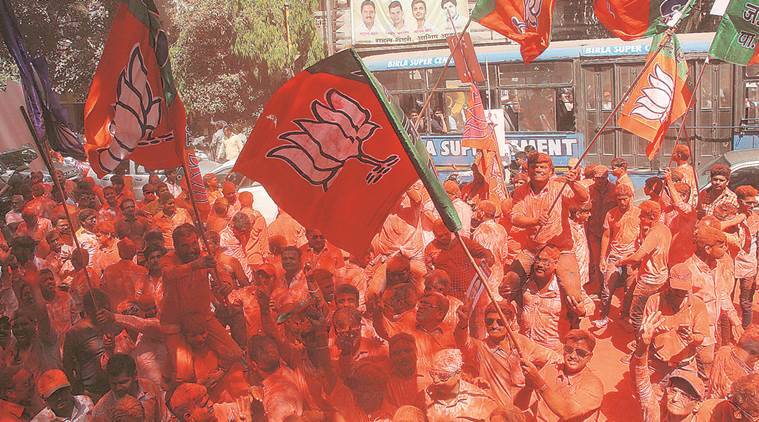
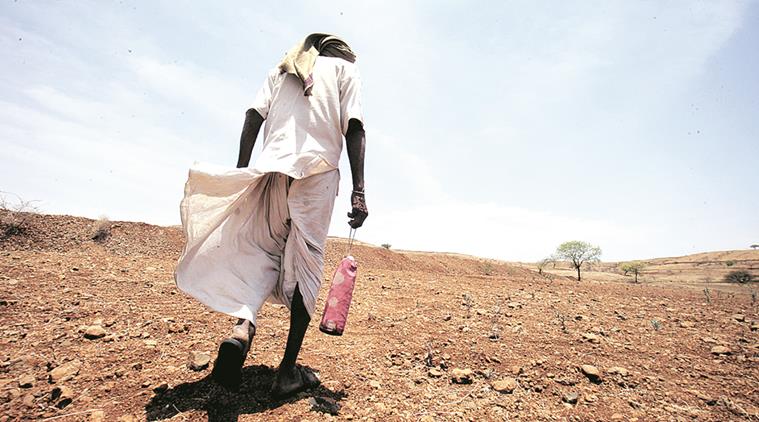
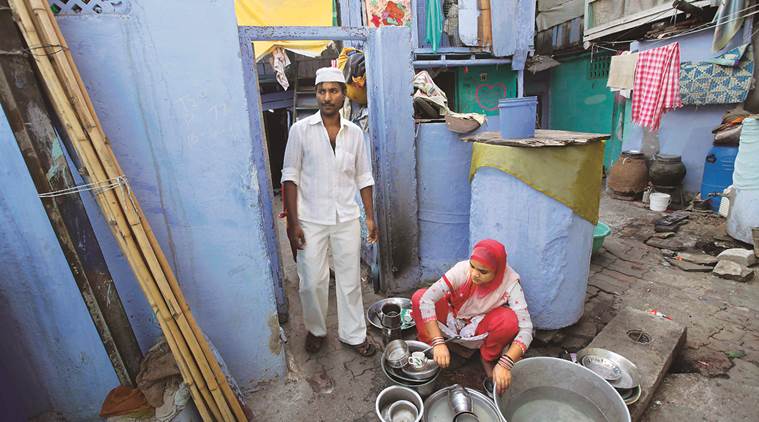
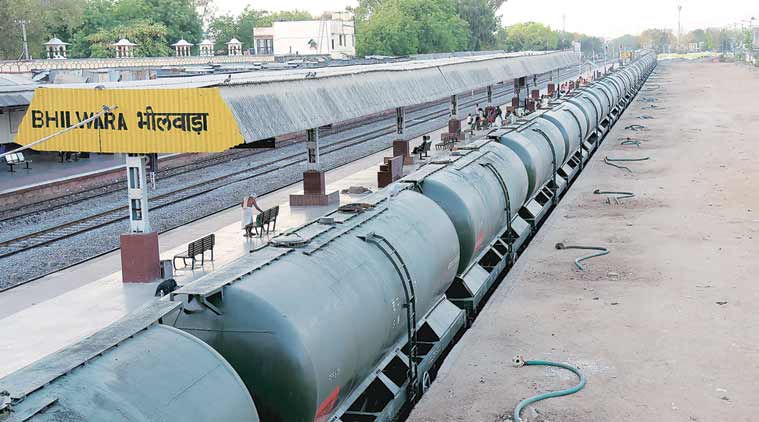
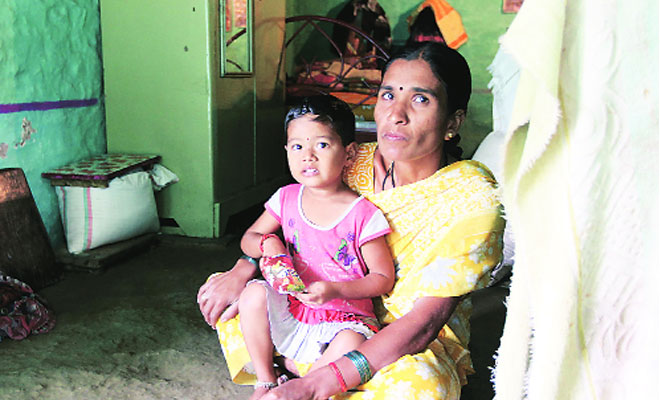
Outrage was the overriding emotion in this power-loom hub, among families of those killed in the blasts, politicians, lawyers and those discharged by a court last month in the 2006 blasts case.
Nisar Shah (35), whose lost his father to the Malegaon blasts of 2006, at his residence on Friday. (Photo By Pavan Khengre)
ATIKH RASHID
Not a surprise, legally wrong, calculated move. These were just some of the words that echoed in Malegaon on Friday after the National Investigation Agency (NIA) dropped the names of six accused, including Sadhvi Pragya Singh Thakur, from its chargesheet in the 2008 blasts case.
Outrage was the overriding emotion in this power-loom hub, among families of those killed in the blasts, politicians, lawyers and those discharged by a court last month in the 2006 blasts case. The NIA move also triggered protests by local units of the Congress and Samajwadi Party.
The twin blasts occurred in the congested Bhikku Chowk on September 29, 2008, on the night of Shab-E-Qadr as residents were out shopping for Eid.
“Why is the NIA so keen to give Sadhvi and others a clean chit? You see the way we were treated despite the investigating agency not having a shred of evidence and now you see these people getting a soft treatment from the same agency and the government. But this hasn’t come as a surprise at all, this was expected,” said Raees Ahmad, who was among those discharged by a Mumbai court last month in the 2006 blasts case.
Nisar Shah, 35, whose father 65-year-old Harun Shah died in the blast, said the accused deserved punishment.
“My father had gone out for tea after offering namaz. He was badly injured in the blasts and died the next day. We don’t know much about the case, but I remember a woman in saffron clothes being arrested. If she has done it, she should be punished,” said Shah, a father of four who works as a labourer in a power loom.
“It’s a calculated move by the BJP government and we knew it was coming,” said Aseef Shaikh, the Congress MLA who represents the region in the Maharashtra assembly.
Freelance journalist Mubasshir Mushtaq questioned the NIA’s contention that the motorcycle on which the bombs were planted was linked to Sadhvi Pragya but she had not used it for the two years leading up to the blasts.
“She can’t be absolved of all charges at the investigation level itself,” said Mushtaq.
“This is similar to the argument adopted by Rubina Menon in the 1993 serial blasts of Mumbai. The elderly woman is behind bars for life for owning the Maruti van which was found abandoned at Worli with AK-56 rifles and hand grenades. She had also argued that she wasn’t using the car and didn’t know to drive,” said Mushtaq.
Lawyer Irfana Hamdani, who had defended some of the 2006 blasts accused, argued that the evidence against all accused in the 2008 case was stronger than that against the nine Muslim men who were discharged in the earlier case.
“There are at least a dozen CDs containing audio and video evidence which sheds light on the conspiracy and the role played by Sadhvi. There are also a number of documents, apart from the ownership of the bike which was used to plant the bombs. The law says that material and documentary evidence should weigh over the oral testimony of witnesses. If the NIA is giving her a clean chit, saying there are testimonies which support her innocence, then it’s legally wrong,” said Hamdani, who stays about 100 metres from the blast site.
From special orders procuring equipment to the shunting of trains to give Jaldoot preference. From men working day and night, to hurdles, expected and unexpected. From water Miraj is withholding from own, to water now coming to Latur.
ATIKH RASHID in Miraj & MANOJ MORE in Latur
It was in January 2013 that Maharashtra first considered running water trains. It was again to provide water to drought-hit Marathwada. At a Cabinet meeting, then chief minister Prithviraj Chavan said that initial discussions had been held with the Railways to arrange three wagons to transport 5 lakh litres of water daily.
Last year, as the drought in Marathwada persisted, the idea was thrown about again, this time to transport water to Latur from Pandharpur’s Ujani Dam, 190 km away.
Finally, when the government picked Miraj, Sangli, 342 km from Latur — the longest distance for a water train in India — to supply water, it was the most natural choice.
The Krishna basin, extending over Andhra Pradesh, Karnataka and Maharashtra, is known for its prosperity. The Warna Major Irrigation Project, with a capacity to store 34 TMC (thousand million cubic feet) water and holding 15 TMC of water at present, keeps the area around Miraj one of the few Maharashtra regions unaffected by the drought.
Among lush fields of grapes, sugarcane, banana and raisins, farmers say they haven’t faced water scarcity in years. Residents talk about getting water supply “twice a day”.
The water train to Latur, since named Jaldoot by Pune Divisional Railway Manager B K Dadabhoy, draws its water from the Krishna river downstream of Warna dam.
From there to a Latur doorstep, it is a Rs 2.8-lakh, 25-hour operation now, for every run with 10 wagons. The wagons are clover-green in colour, having been delivered clean and freshly painted from the Railways’ Kota workshop. Eventually, the Railways plans to carry 50 wagons every trip.
Day and night at Miraj
The first of the 50 ‘BTPN’ tank wagons arrived on April 10, one day before the trial run. The Kota division of the Railways was chosen for supply of the rake because it has an “expertise” in cleaning tank wagons, says Chief Workshop Manager P K Tiwari.
“Tank wagons are primarily used to transport petrol, vegetable oils, molasses and crude oil. Earlier, we had cleaned crude oil wagons to be employed for high-performance petrol,” says Deputy Chief Mechanical Engineer Haripal Singh.
To carry water, the wagons were steam-cleaned, then cleaned with chemicals, scrubbed, and finally washed with high-pressure water jets, he adds.
At Miraj, preparations were on by then for the task ahead.
A jack well set up by the Railways in 2009 at a ghat 4.5 km away used to already pump 16 lakh litres of water for daily use at the rail junction. The water would first be piped to a water treatment plant through underground pipelines before reaching the station.
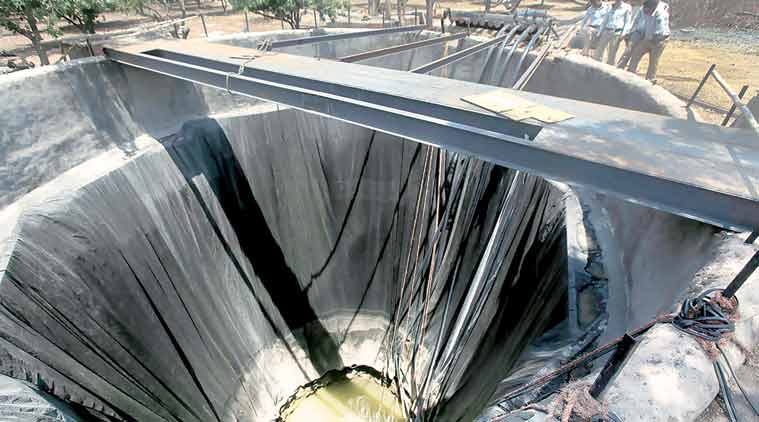
Water being emptied in a well in Latur (Photo by Pradip Das)
Water being filled into tankers near the Latur station. 50 rail wagons would hold water equal to 450 tankers. (Express Photo by Pradip Das) Water being filled into tankers near the Latur station. 50 rail wagons would hold water equal to 450 tankers. (Express Photo by Pradip Das) For supply of 5 lakh litres to Latur every day, the Miraj administration has reduced its own demand to 13 lakh litres. Still, that means that for the additional water, the jack well and the pump are working overtime. The four-hour resting time at the water plant, which has a capacity to filter 1.5 lakh litres per hour, has also disappeared.
Right now, it is taking three hours to fill a single wagon with 50,000 litres of water at Miraj. Work is on to set up bigger, 315-mm-diameter pipes for carrying water from the plant so that the 50 planned wagons can be filled in 10 hours. Eventually, officials also plan to fill 25 wagons simultaneously instead of two-three wagons.
“The distance between the water treatment plant and the Miraj rail yard is 2.7 km, which needs to be covered using this pipeline,” says an official with the Maharashtra Jeevan Pradhikaran, the state Civic Water Supply Department.
A legendary well next to the station, Haidar Khan bawdi, is also being emptied out and cleaned, before it is filled with water again for use as and when needed.
Fifty-five-year-old Julekha Begum, who claims to be the traditional “mujawar (caretaker)” of the bawdi, says it “never dries up even in the worst of droughts”.
Four teams of labourers supervised by engineers are working day and night to finish the work. “There are about 40 personnel working at five different sites. Apart from laying of pipes, the work involves erecting a water-filling facility at the rail yard, installing a bypass valve at the water treatment plant, creating two small tunnels under the railway tracks so that the pipes can cross the railway lines and installing new pumps at the well,” says Prashant Joshi, who is a site engineer with the contractor hired by the Maharashtra Jeevan Pradhikaran.
Since the work began, hurdles have been constant. For instance, a farmer over whose land 100 metres of the pipeline had to be laid refused to cooperate, threatening he would “confiscate” the pipes if they kept lying there “a day over two months”. “It took one and a half days to allay his doubts,” says Joshi.
Besides, work near the tracks can only happen when there is no train traffic, which is mostly between midnight and 3 am. “Mainly freight trains operate at this time, apart from one express train,” says Vivek Kumar, Transportation Officer, Miraj.
Getting the PVC pipes from Jalgaon, 400 km away, also proved problematic. Pipes with a diametre of 315 mm or more are made only on order. “Of the total 2,000 metres of PVC pipes we need, we have only received 600 m,” says a supervisor.
At the station, two teams of Railway’s technical staffers and labourers are working in shifts, supervised by senior officers, to make sure that the water-filled Jaldoot is dispatched at the soonest (four trains, of 10 wagons each, have run so far in five days).
After the first Jaldoot ran on Monday April 11 morning, it took the Miraj junction administration another two days to dispatch the next one, due to problems filling water, although the plan was to send the next one on Tuesday.
It takes 3 hours to fill a wagon with 50,000 litres at Miraj right now. Plan is to cut this to 10 hours for 50 wagons. (Express Photo by Arul Horizon) It takes 3 hours to fill a wagon with 50,000 litres at Miraj right now. Plan is to cut this to 10 hours for 50 wagons. (Express Photo by Arul Horizon) Currently, a majority of the BTPN tank wagons which arrived from Kota stand idle, with only 20 in use so far. The capacity of each wagon is 54,000 litres, but they are being filled only till 50,000 litres. To hasten the filling of the water wagons for the first train run, officers of the Carriage and Wagon Department had even stopped the water supply to three other platforms at the railway station. However, this had led to a series of pipe bursts.
Since then, filling of the wagons has been divided into three shifts — 9 pm to 4 am, 6 am to 9 am and 2 pm to 8 pm. At the end of every shift, the train is moved from platform no. 2 (where the filling usually happens) back to the yard, to make space for other trains to halt at the station.
“Many other trains require water-replenishment at Miraj. We can’t avoid that although it slows down the filling of Jaldoot due to low pressure,” says Kumar.
However, others too claim their supply has been hit. Residents of the railway colony right next to the Miraj junction claim they have not received drinking water for four days. The supervisor of the toilet and urinary block at platform no. 1 says its water supply has been cut off since April 11, leading to complaints from visitors.
Concedes B K Dadabhoy, the Divisonal Railway Manager, “At present, we are filling the wagons by curtailing the water supply to railway staffers’ colonies at Miraj and by only half filling the other trains… We are doing our best.”
Senior Railway officials have also been travelling in the engine and guards cabin of the Jaldoot, travelling for at least a couple of stations to ensure everything runs smoothly. On Wednesday morning, during the second water run, the excitement was palpable, and once the train picked speed, many of them took out cellphones and clicked photographs aboard the Jaldoot.
“It’s not for fun,” clarified one of them, travelling in the engine room. “We will send these to our officers so that they know we have done our job well and responsibly.”
At the other end of the train, guard P U Asaware almost stood constantly, clutching the green flag and waving it every few minutes as the train crossed stations overtaking other passenger trains parked on the side to let the Jaldoot pass.
“Other goods trains remain parked at the station for hours for want of line clearance. The first Jaldoot took 17 hours to finish the seven-hour journey as it was detained in Osmabanad. Hence, now the rail administration is making every effort to ensure it reaches Latur in six-seven hours,” says Asaware.
Senior Commercial Manager (Solapur division) R K Sharma admits that this track being a single-line section is a problem. However, he adds, the restrictions placed for Jaldoot don’t affect express trains, whose timings don’t coincide with the water train. “Yes, some goods train do get affected, but that is negligible.”
The well near the Latur station. where water from the water train is emptied, can hold 17 lakh litres. The well near the Latur station. where water from the water train is emptied, can hold 17 lakh litres.
Sleepless at Latur
At the Latur station too, Jaldoot arrives to a special welcome. The Railways have dedicated a special track, that ends behind the main station, for the water train to halt.
Rubber pipes help empty water from the wagons into an 850-m-long RCC pipeline, leading into a well nearby. The emptying of water takes upwards of three hours.
The RCC pipeline was laid by Sunday night, before the first trial run. Later, holes were drilled into the concrete pipeline for inlet pipes coming from the wagons.
Officials say they began work as soon as Revenue Minister Eknath Khadse, deputed to Sangli by Chief Minister Devendra Fadnavis, made the announcement on April 5. Officials of the Latur Municipal Corporation, the district collectorate, Railways and the Maharashtra Jeevan Pradhikaran held an emergency meeting and ordered the RCC pipeline and a 250-m high-definition plastic pipeline, to be delivered by a contractor on priority.
Once the pipelines arrived, over 300 Railway men were put on the job. “The work to lay the pipelines was carried out round-the-clock,” say officials of the Maharashtra Jeevan Pradhikaran.
Latur Municipal Commissioner Sudhakar Telang says the government sanctioned Rs 3.50 crore on an emergency basis for laying the two pipelines, and another one on which work is on.
Most of the work, say officials, was done in 48 hours.
The jack well for pumping water was provided by an S R Deshmukh, for free. “We requested him to make his jack well available for some time, and he readily agreed,” district officials say.
After the RCC pipeline takes the water from the wagons to a nearby well, which has a capacity of 17 lakh litres, the other, 250-m pipeline takes it to an open ground nearby. Here, water is filled into four tankers and sent to Latur’s water treatment plant 3 km away, before being supplied to different parts of the city. “The water we get from Miraj is treated, but we are re-treating it to check against any contamination as a result of transportation,” says Latur District Collector Pandurang Pole.
Pipeline being laid at Latur railway station. The idea is to cut down time taken in use of water tankers. (Express Photo by Pradip Das) Pipeline being laid at Latur railway station. The idea is to cut down time taken in use of water tankers. (Express Photo by Pradip Das) He adds that the filling of the well, and carrying water away from it to the filtration plant is simultaneous. Now a pipeline is being laid from the well to the water filteration plant too so that tankers eventually aren’t needed.
Giving an idea of how the water train would help Latur, Pole says, “It will ease our water travails. Instead of providing drinking water every six to eight days, we will be able to provide it every four days.”
The water brought by 50 wagons would be equivalent to 450 tankers supplying daily, he adds.
However, Railway officials say, the 50-wagon train will be only making trips every two to three days as filling water takes time.
Latur city, with a population of five lakh, has 1,000 borewells belonging to the civic body, and an estimated 15,000 private borewells. “The city used to get 60 million litres of water daily from Manjara dam, which has run dry. Now our sources are Terna dam and Dongargaon, private and civic borewells, private tankers and the train,” says the municipal commissioner.
The Latur district rural areas, with 943 villages, have a population of another 18 lakh. The water levels in the 131 smaller dams in the district are also depleting fast.
The villages have been demanding that the Jaldoot be stopped en route to provide them water too and not just to the city. Shailesh Saroday, president of the Harangul Budruk, a students’ association, says they have urged the district collectorate to stop the train at Harangul railway station, outside the Latur city limits. “Since the train is bringing in 5 lakh litres of water, they should at least make one wagon available to us,” he says. “Why cater only to city areas?”
In Ward No. 9 in the heart of Latur city, with 15,000 residents, water was supplied from the third Jaldoot that arrived Thursday night. “We have all heard that water from the train will help us get drinking water in a much shorter time,” said Sanjay Rajoure.
Half of Najma Pathan’s husband’s income, of Rs 4,000 per month, from selling household wares on handcart, goes into buying water.
Why did they have to wait so long for Jaldoot, she asks. “Why don’t they bring in more trains and more water from wherever it is available?”
The Precedents Australia used rail networks to transport water as far back as the late 1800s. In 1952, drought-relief water shipments were sent to the mining town of Broken Hill in New South Wales via six water trains a day. In 2008, the Queensland Rail Freight of Australia delivered water to Cloncurry town in north-central Queensland.
The US has also used water trains for long. As per Illinois State Water Survey, 1971, Mount Vernon got drinking water by railway tank cars in 1905, 1925 and 1945. The January 1945 operation, with 100 tank cars, lasted 45 days and cost over $50,000 then. As late as 2015, rail cars were proposed in the US to provide potable water to small communities in California, reeling under a four-year drought.
Meet Parvati Suryavanshi aka Parubai, the waste-picker who started picking roles in student projects at India’s best film school.
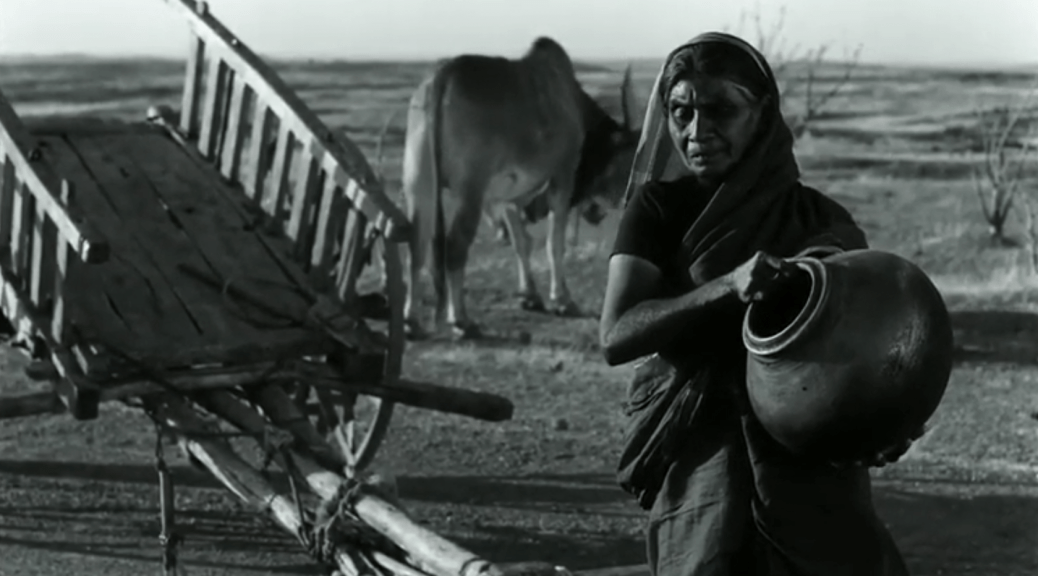
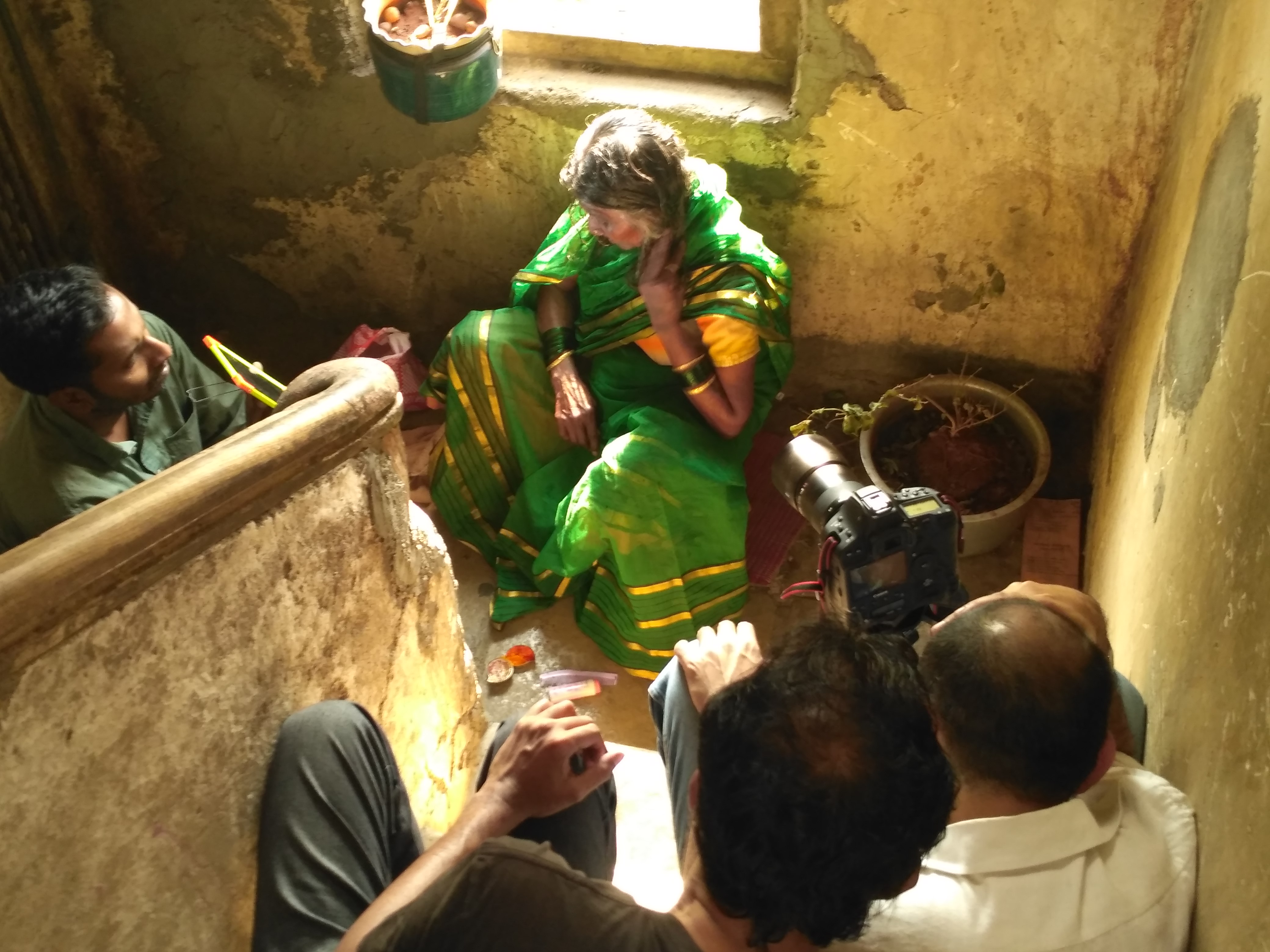
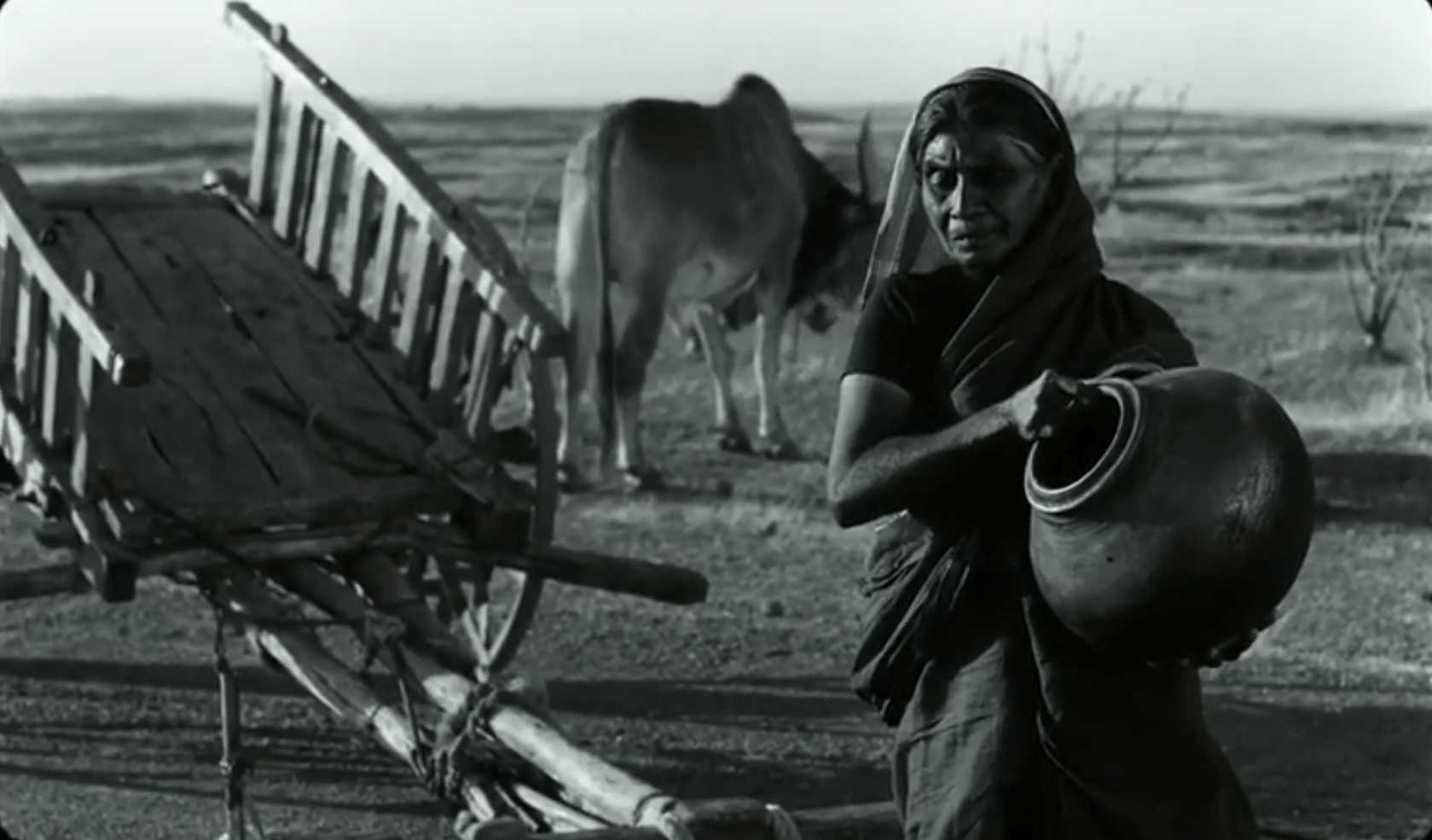
A still from Kamakshi (directed by Satindar Singh Bedi) in which Parubai plays the titular role. The film was screened at Berlinale 2015.
If she were versed in actorspeak, she would tell you that the story of the lead character she plays in the short film Kamakshi could well be her life’s narrative. She would have drawn parallels between her character who scrounges for water to sell to the needy and her own youth, during the 1972 famine, when she left home to work as a labourer on well construction sites.
But you hear nothing of this when you meet the waste-picker pottering about the sleepy sprawling campus of Pune’s Film and Television Institute of India (FTII). One thing she takes pride in is that she hasn’t stolen a single piece of metal from the campus in the three decades she’s been there.
Along with picking used papers, glass, plastic to be sold as scrap, Parubai aka Parvati Limbaji Suryavanshi, 78, started picking up roles in student projects on campus.
Her IMDb page describes her as “an actress known for Kamakshi (2015) and Makara (2013)”. Kamakshi, the diploma film of Satindar Singh Bedi draws from the mythological figure of the goddess of compassion. It made good noise at national and international festivals: competed at Berlinale 2015, was part of Indian Panorama at International Film Festival of India (IFFI) and bagged four awards at Mumbai International Film Festival (MIFF). Parubai plays the titular role of the old, lonely yet determined woman obsessed with obtaining and providing water in the drought-hit terrain. Prantik Basu-directed Makara was shown at 2013 Rome Film Festival.
She has worked in over 20 student films till date. “More, but not less,” she says in Marathi, the only language she is fluent in. With the students, she speaks in broken Hindi.
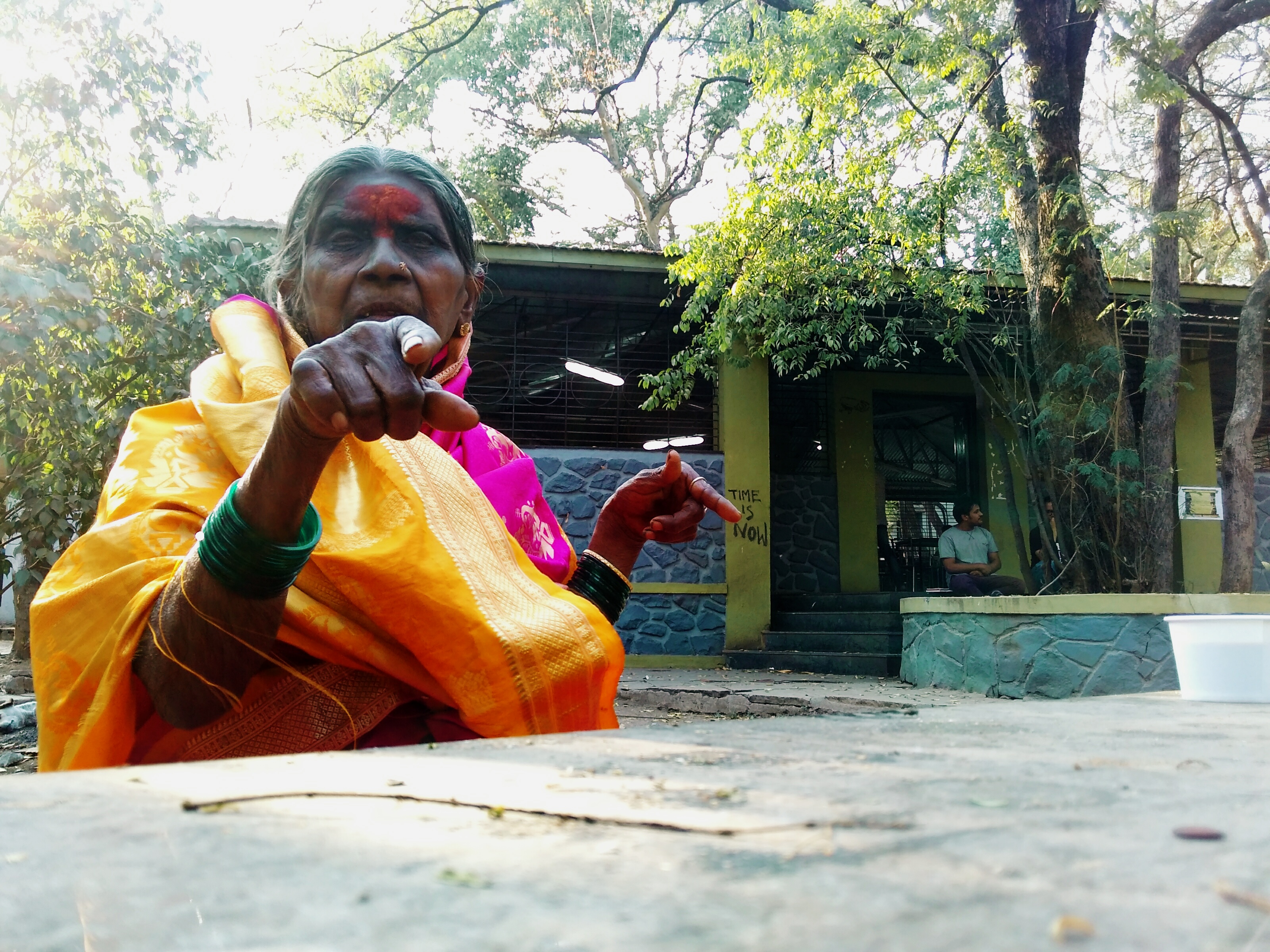
Parubai can be spotted at FTII Canteen on most afternoons. (Photo Credit: Atikh Rashid)
The landless labourer in water-scarce Solapur didn’t have it easy even before the 1972 famine. “My husband and I worked as daily wagers in farms. The drought took away all work. There was no food. Our cows and calves died, we had no time for them as we struggled to feed ourselves,” she says.
The family climbed on a truck when a contractor came looking for cheap labour. Taken to Gujarat, husband and wife spent days breaking stones for road construction, digging wells, harvesting crops. Nights were spent in temporary shelters or in the open.
“My husband was reluctant to take me along, but I insisted. We went wherever work took us: Gangthadi, Vapi, Navsari,” she says. “My husband would lift big stones and put them on my head to carry. Bigger stones meant more money.”
“I don’t understand cinema at all,” she says. For her, acting is doing what’s told once the director shouts: ACTION!
Of all the films she has worked in, her favourite is Kamakshi, although she grumbles that she looks terrible in it — “almost like a witch”. The film demanded great amount of hard work from the team, especially the lead.
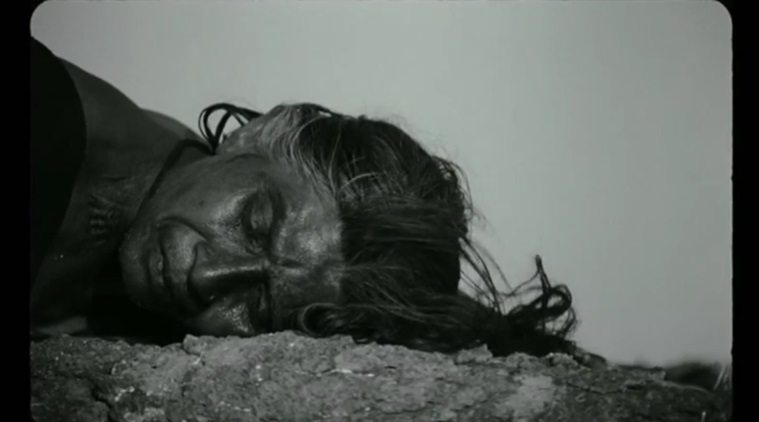
“That shoot really tired me out. The sequences were really difficult and tricky. I had to climb down the well, sleep in water and even chew stones. All this in one sari,” she says. She had to wear the same sari throughout the film. “I thought I would contract pneumonia. But you have to suffer. That’s how it is during a film shoot,” she adds.
“Potachi khalgi bharnyasathi aamhi kaam karto (I do this work to feed myself), since there’s no one to support me. Even today, I don’t have electricity in my house,” she says.
Walking 4 km to FTII is part of her daily routine. Even when there’s no work, she leaves for FTII in the afternoon and spends her evenings on the campus. She says the students mean more to her than her own son and grandsons. Pointing at her sari, with great pride, she says a Bangladeshi student’s mother brought it all the way from Dhaka for her.
While some say she is an ideal actor, does what’s told, others feel she can only fit into roles with limited dialogues. Some think she’s a natural, others feel she overacts. Despite that, roles continue to land in her kitty. She’s just finished shooting for a commercial film in Pune and Latur.
During an academic exercise at FTII. (Photo Credit: Atikh Rashid)
Makara-director Basu says, “I was looking for good storytellers. She fit the bill. Her scenes were written from her own experiences and anecdotes. She has a peculiar way of talking which I find very interesting as a filmmaker. Also, having been associated with film production process for so long she’s quite adaptable to shooting conditions and physical challenges.”
She lost her husband a decade ago. One of her two sons (she had lost three more to the 1971 famine) died a few years ago. The surviving one, she says, is a drunkard whose wife and sons left him and that he feeds off his mother. “It’s here (FTII) I find some solace. I’m alive only because of these kids (students),” she says.
Over the last four years, she has developed cataract which hinders waste-picking. For acting gigs, the students pay her a fee — often her sole source of income. She badgers students for cash when there are no assignments.
Until 2009, when she earned Rs 11,000 for a diploma film, she stayed in a two-tin-sheet shanty. Her house now is located in Janata Vasahat slum on the steep slope of the Parvati Hill. She’s among the first few settlers there. Parubai and her son live in the rear, hidden from public view. The son sold off the copper utensils, the meagre furniture, the tin sheets off the roof. “I had built this hut from money I got for that film. At least, I have a proper place to sleep now,” she says.
Another still from Kamakshi (2015)
She reminisces about her time in Gujarat where the husband-wife earned about Rs 10 a day but had to flee after the muqaddam (expediter) started punishing them for helping a co-worker whose family fled after taking an advance. Parubai left with her husband and children, too, and roamed for days, on foot, in buses and trains, until they reached Pune. She did odd jobs until 1982-83, when she joined the Kagad Kach Patra Kashtakari Panchayat as a waste picker. A couple of years later, she got a waste-picking job at FTII and with that Parubai made her modest entry into the world of cinema.
Without enough water to irrigate a summer crop, a village in Maharashtra takes a three-month holiday.
ATIKH RASHID
Hivre Bazar,a village with a population of 1,300,is on a three-month holiday. Residents of this village in Parner taluka of Ahmednagar district in Maharashtra, most of them farmers who otherwise spend this time of the year nurturing summer crops of groundnut or tomato, are organising fairs, arranging cultural programmes, taking sight-seeing tours or just enjoying leisure at home.
The decision to take a three-month break from farming, from March to May, was taken by the villagers in a gram sabha (village meet) unanimously. According to villagers, due to a sparse rainfall last monsoon, there wasn’t enough water to sustain a summer crop and a crop failure was likely. That would have been a wastage of effort,money and water. So instead of planting a summer crop, we unanimously decided that we will rest and also allow our fields to do the same, says Sakharam Tukaram Pawar, a villager.
According to Popatrao Pawar, the deputy sarpanch who played a pivotal role in converting this drought-prone village into a model village, the villagers had gone on a similar break in 2003, again due to less rainfall.
Ahmednagar is among the 12 drought-hit districts in Maharashtra. The drought has resulted in severe shortage of drinking water and has forced many farmers to pull out standing crops as they had no water to irrigate them.
Pawar says, “We have a water audit system in the village which is run by village students. Our experience of the past 20 years shows that if the village receives 400 mm of rainfall in the monsoon season,we get enough water to meet our drinking and crop needs in all the three seasons kharif, rabi and summer. This year,we have had only 190 mm of rainfall,which means just enough water for drinking and kharif and rabi crops. Had we planted a summer crop, we would have exhausted our drinking water.”
Once a drought-prone village,Hivre Bazar now has two percolation tanks with a collective storage capacity of 10,000 million cubic feet. A weak monsoon failed to fully recharge these last year. Apart from percolation tanks, there are 294 wells,16 earthen dams and seven cement storage tanks. The village has won accolades for watershed development work and rural welfare schemes.
Once the water audit done in February showed that the water stored in the dams would just be able to meet drinking needs of villagers and the livestock,the situation was explained to every villager in a gram sabha which unanimously decided against planting the summer crop. “We told them that only 25 per cent families in the village could plant a summer crop with the water from their wells. But they will have to risk a crop failure. In that case,the remaining 75 per cent will have to depend on tanker water for drinking. So these 25 per cent families sacrificed the summer crop for the water needs of fellow villagers”, says Pawar.
Currently, every household in the village gets 500 litres of water through the village water distribution scheme which is run entirely by women. Pawar says the decision to hand over control of water to women was taken because as homemakers,they are the ones who have to deal with the scarcity of water.
Sakharam Patil,another villager,argues that sacrificing his summer crop doesnt actually mean that he has to forgo the income from his field. There were strong chances that my summer crop would fail or generate very little yield, resulting in losses on the investment. Avoiding these losses is also a kind of profit. Besides, it’s tiring to toil in the field year after year. Now we have holidays and have also allowed our fields to take some rest. A rejuvenated soil will also give us a better yield next season, he says.
Villagers are making the most of their free time by organising fairs and cultural programmes. We are busy holding jagran-gondhal and bhajan-kirtan. Women are using this opportunity to make pickles and poppadums. Some families have gone out. Once it rains,we will resume work in the farms with renewed vigour, says Raosaheb Pawar, a villager.
Pointing to low production this year,Balasaheb Darade says don’t call us hoarders without taking into account ground realities.
ATIKH RASHID
EVERY time onion prices spiral up,traders in Lasalgaonoften called Asia’s largest onion marketare dubbed villains in an insidious plot to put the otherwise humble commodity out of reach of the common man. Thats about the only time Lasalgaon,a village of around 15,000 people,located about 60 km from Nashik,makes news.
Among the 40-odd traders operating in the Shri Chhatrapati Shivaji Agriculture Produce Market Committee (APMC) of Lasalgaon,which exclusively deals in onion trade,Balasaheb Darade is bewildered at how the fate of even distant governments comes to rest on his bulbous produce. According to him,that’s because of the entirely baseless media portrayal of them as hoarders, without taking into account either trade mechanisms or the marketing chain.
Claiming that production has been low this year due to drought,the 30-year-old says: It is a business like any other. We buy the produce from growers and sell it to traders across the country keeping a certain profit. Depending on the market behaviour we sometimes make profit and there are also days when we lose money. While certain amount of produce is stored like in any other tradethe allegation of hoarding of huge quantities is baseless. If production is lower,the prices are bound to increase.
As per state government estimates,there has been a 40 per cent drop in market arrivals between April and July at Lasalgaon. While in 2012,the four months saw arrival of 12,58,995 quintals,in 2013,the same period saw just 7,51,833 quintals.
Unlike other agriculture markets which open very early in the morningalmost at the break of dawnLasalgaon traders such as Darade start their day late. The market here opens at 9 am.
“In the onion trade you have to be very careful about the quality of the produce. During day time you can inspect the produce thoroughly,” says Darade,who gets up at 7 am and has a quick bite and tea before he reaches the market, 2 km away, by 8-8.30 am.
Before the market opens,Darade speaks to buyers in markets such as Delhi, Kolkata, Bhopal to confirm the demand. “Based on their demand,I go around the marketplace inspecting the produce and placing bets in auctions. The morning session ends at 12 pm. The market resumes again at 3 pm and closes at 6 pm. Remaining in contact with prospective buyers is most important part of the business,” he says.
They can only flourish if traders even far away associate their name with good quality, Darade underlines.
On any given day, he can be seen among the reddish-brown heaps Lasalgaon traders do not deal with produce in gunny bags inspecting the onions closely. We traditionally deal with loose onions. The grower has to empty his truck in front of us. It makes quality control easier,you can check the produce thoroughly and it reduces the chances of a farmer selling you spoiled onions hidden at the bottom of gunny bags, says the trader. No other onion be it from Karnataka, China or Pakistan can rival the Nashik varieties in taste, size and colour. But you have to make sure that you only supply best of the best to do good in the long run.
On an average,the Lasalgaon market receives 8,000-10,000 quintals of onion everyday. This is down to 5,500 to 6,000 quintals this season.
Darade has been in the business for 13 years,having inherited it from his father. “My father worked in another traders shop for decades as an employee. Later he set up his own shop in the APMC. I studied in a local college till Class XII and then dropped out to help him in the business. For the past five-six years,I have taken over entirely,” says the father of a two-year-old daughter.
There is another reason the accusations of hoarding large quantities don’t hold water,Darade says. During periods of supply shortage,the marketing board vigilance is so strict that it is impossible to hoard big amounts illegally. “This year several traders had stored onions,which were bought from farmers in April-May during the harvest glut, at Rs 1,000 per quintal. However,when the prices started climbing up in July and reached Rs 1,500 per quintal,most of the stored produce was sold off at a profit of Rs 500 per quintal. We had not imagined that the prices would go as high as Rs 4,500. At present,we are buying and selling onions at a margin of Rs 50 to 100 per quintal. The APMC administration checks the total buying,total selling and storage on a daily basis and sends a report to Mumbai,” he says.
Storing also comes with its own costs as well as the ever-present risk of prices falling. You have to pay the rent of godowns and there is a 15-20 per cent weight loss of produce due to evaporation. There have been years when we had to sell a produce which was bought at
Rs 1,000 per quintal at Rs 800. You can’t store the produce longer,for onions get spoiled, Darade says. Even if you take utmost care and make sure that not a single onion rots, you lose 20 per cent of produce weight to evapo-transpiration in a couple of months. There’s no way you can escape it in the hot weather.
Giving a more recent example, he points to a pile of onions lying in his shed. “I bought two truckloads of this (400 quintals) on August 14 at a price of Rs 4,500 per quintal. The next day was Independence Day and by the morning of August 16,when the market reopened,the prices had collapsed by Rs 1,000 per quintal to Rs 3,500 due to news of banning of exports and imports from China and Pakistan. In the past few days,the prices have further come down and now I will have to sell this produce at a net loss of about Rs 1,000 to 1,200 per quintal. Such is this business,” he says.
After getting home from work,Darade likes to spend some time with family,which mostly involves business discussions with father and taking strategic decisions on investment. “Before going to sleep I spend some time with my daughter and watch TV. I like comedy shows and Hindi films,” he says.
The tears shed over onion daily on news channels don’t escape his attention, but Darade is not disheartened. Irrespective of the highs and lows,I will stick to onions because it is the business of onion which has not only sustained my family but the entire region for decades,” he says.
The bungalow, which is being ‘renovated and refurbished’ by the Central Public Works Department, has doubled in size after a special exception was made to sidestep rules that limit the area of a former President’s house.
In April 2012, when she was three months away from the end of her term, then President Pratibha Patil gave up the palatial bungalow that was being built in Khadki, Pune,to serve as her post-retirement residence, after it got mired in controversy.
Subsequently, the Centre identified and allotted to her what was considered a rather modest bungalow named Raigad near Chatuhshringi Hills on Pashan Road.
It has now come to light that the size of this bungalow,which is being renovated and refurbished by the Central Public Works Department,has doubled in size after a special exception was made to sidestep rules that limit the area of a former President’s house.
In July 2012,when the Union Ministry of Urban Development (MoUD) took possession of the bungalow which was the official residence of the director of police wireless it had a built-up area of 2,906 sq ft. During renovation,this has gone up to over 6,000 sq ft.
The President’s Pensions Rules, 1962, say that if a former President is provided accommodation on a leased property,the living area should not exceed 2,000 sq ft.
The MoUD has taken the bungalow on lease from the Maharashtra government on an annual rent of Re 1. Sources said that while MoUD was willing to pay rent at market rates,the state government decided to lease it almost free of cost.
MoUD secretary Sudhir Krishna said an exception to the living area rule was made by the Union home ministry for Patil,who is expected to move in around mid-May.
“The rules were made by the home ministry and they have made a relaxation in this case. They have approved the construction plan of the bungalow. It’s their mandate. Our job is to construct what we have been asked to construct. The rule is there but a relaxation can also be made by the concerned ministry,” Krishna told The Indian Express.
Work on the bungalow started in December 2012 and the structure has since undergone a complete overhaul. Several new rooms have been added for Patil,her office and her staffers.
The house plan shows it has two bedrooms, a master bedroom, a living room, a lounge, a dining room,a dressing room,a library,a pooja room,a kitchen-cum-store room, a separate store room,a visitors lounge, an office for the ex-President,a porch,a covered courtyard,five toilets,an office for the personal assistant, five staff quarters, a security cabin, a guards room and a one-room-kitchen unit for the staffer.
A recreational ground will be developed on 5,670 sq ft comprising a lawn and other garden essentials. The total size of the plot is 56,239 sq ft and the CPWD tender said it estimated the cost of the entire renovation at Rs 1.03 crore. Officials refused to disclose the value of the final contract.
CPWD also issued a separate tender for horticultural at an estimated cost of Rs 6.66 lakh.
Under the agreement between the state government and MoUD,the bungalow will remain with the MoUD until either Patil or her spouse is alive. It will then be returned to the state government which has to pay MoUD the expenditure incurred on the renovation
Dayanand Patil’s case is a sad commentary on the state of Indian terror investigators who let preconceived notions and assumptions guide the probe than the evidence at hand. A year after the serial low-intensity blasts on Jangli Maharaj Road, Atikh Rashid travels to Basavkalyan in Karnataka looking for Patil, the humble tailor and the only person injured in the blasts, who spent two months in police custody as a “prime suspect” before being let off.
A member of the Bomb Detection and Disposal Squad (BDDS) at work on August 1 2012 (Picture: Arul Horizon for The Indian Express).
ATIKH RASHID
THE blasts on Jangli Maharaj Road were said to be of low intensity, but they were strong enough to devastate the life of the sole injured – Dayanand Patil (32), a tailor who worked at a shop about 200 metres from the blast sites. A year after the August 1 incident, shockwaves of the blasts are still felt at Patil’s house in Kohinoor village in Bidar district of Karnataka, around 420 km from Pune.
The old stone-built one room house, which the five occupants fear can crumble any moment in this year’s strong monsoons, stands testimony to the family’s hardships. According to Janabai Patil (70) Dayanand’s mother, the blasts for which Dayanand was initially blamed — not only ruined his reputation but also rendered him unemployable, thus worsening the financial situation of the poor family dependent on farming for survival.
A year ago, Patil (32), who worked as tailor at a local dye-cleaning shop and stayed at Uruli Kanchan in city outskirts, had shot to infamy after eye-witnesses of the serial blasts on Jangli Maharaj Road claimed that one of the bombs had gone off in a bag carried by Patil. The “possession of the bomb” had led to local police and the anti-terrorism squad seeing him as the prime suspect in the blast conspiracy.
Later, the investigators exonerated Patil and booked four other persons who were arrested by Delhi Police for the planning and execution of the blasts. ATS charge-sheet in the case names Patil as a witness. Police would later reveal that Patil who had initially maintained that he had picked up the bag “mistakenly” told them later that the polythene bag, lying unclaimed at the protest site, contained a cake box and he had picked it hoping to take it home to surprise for his three-year-old daughter.
For two years before the incident, Patil stayed in a one room tenement in Mhetre Chawl in Uruli Kanchan – about 40 kms from his workplace on Shirole Road, with his wife Satyakala, daughter Kirti and niece Deepali. He would take a train from Uruli to Shivajinagar and then walk to reach h reach Namrata Laundry where he would do ‘rafoo and alter’ jobs for clothes that came for washing and ironing.
Mhatre Chawl in Uruli Kanchan a day after the blast (Photo: Sandip Daundkar for The Indian Express)
Patil was detained by the police immediately after the blasts and a couple of teams would swoop down Mhetre Chawl in Uruli looking for evidence. They would pick up Satyakala for inquiries, leaving behind Kirti and Dipali with neighbours. (She was dropped back home a day later) After two weeks of active interrogation, ATS claimed that Patil was let go. But he wouldn’t reach home for much longer.
“He was with the police for a total of two months, while all kinds of false stories were circulated about his role in the blasts,” Jijabai Patil, Dayanand’s mother tells The Indian Express, a year later. As per Jijabai, during her son’s two-month detention by police, he was kept at a lodge near Gunjan Theatre in Yerawada.
“For around a month, we had no clue about his whereabouts. After a month of detention Dayanand demanded that the police allow him to meet his family once. It was then that an ATS team came to our village and took me, his father, wife and brother to the lodge,” said Jijabai.
Post-Diwali, ATS men dropped him home and told them that he was not responsible for the blasts.
“For months he refused to step out of the house for fear that people would taunt him over his terror links. We advised him to visit our relative’s houses. But people knew about it everywhere. He would stay at home and refused to talk,” says Jijabai.
According to his cousin Venkat Patil, Dayanand sat idle for two months but the family could not afford it. “We sent him to Basavakalyan to find work. However, his newfound notoriety made sure that nobody offered him a good job. He did some petty work but couldn’t earn to sustain the family. This went on for six-seven months. About a month ago, his Mumbai-based sister invited him there to find a job,” said his mother.
Patil’s family refused to share his Mumbai address or contact details of the sister with whom he was staying. The family also requested Express not to contact Patil as it “would disturb him and may also jeopardise his employment”.
‘Worshipping an Islamic saint, having Muslim friends’
According to Patil’s family, during the early stages of the investigation, the police and anti-terrorism squad suspected that Patil was a Muslim convert “and hence” could have had possibly played a role in the low-intensity blasts, led to harassment at the hands of the police and media and remains a stigma which the family still struggles to come out of.
According to Patil’s family, there were several ill-fated co-incidents which led police suspect Dayanand’s role in the blast during initial stages of investigation including –apart from picking up the bag with the bomb – recovery of a passport which showed that Patil had visited Jordan for nine months a few years ago, that almost all persons he was close to were Muslims hailing from Karnataka—home state of notorious terror operatives Bhatkal brothers– and that a before and after the incidents Patil he had received several calls from his Muslim friends.
Dayanand’s wife Satyakala with daughter Kirti at her maternal home in village Wadarga village in Bidar district. (Photo: Sandip Daundkar for The Indian Express.)
Ramzan Shaikh, one of the friends who stayed in the same chawl, told the Express that he was picked up by the police the same night. He had called Patil at 8 pm, the time when bombs were going off on Jangli Maharaj Road. “Although both of us come from Karnataka, I got to know Patil only after we got acquainted in Pune. We used to take the Daund Passenger of 8.05 pm daily to return to Uruli after work. If anyone of us got late he used to call others to check if the train has left the railway station. That day I was getting late so I called Patil on his phone. It seems this raised suspicion and the Police detained me. I had nothing to hide so I told them everything,” said Ramzan.
According to Dayanand’s mother Jijabai, one thing which triggered the “conversion theory” was a discovery made by doctors who performed a medical check-up on him soon after he was admitted to Sassoon Hospital for the burns injuries he had received from the explosion.
“After he was dropped back home by the police, he told us what had triggered the speculations of his conversion. He said during his medical examination at the hospital soon after the blasts the doctors had noticed his circumcised genitalia which raised police’s suspicion especially in the light of the Muslim company he kept. His explanation that it was ‘natural’ did not satisfy the police. And it’s one explanation we have given to hundred times to the police team and the media personnel.”
From the family’s description, it appears that Patil had a rare congenital abnormality called Aposthia in which the thin skin that covers the penis – the prepuce – is missing.
The family had to provide clarifications for several others things, such as the fact that why they, A Hindu family, worshipped a Muslim saint.
Venkat Patil, Dayanand’s cousin and a teacher, said, “This was another question which came our way repeatedly: Why we being Hindus worship a Muslim saint? People would overlook the fact that Madar Sahab was our village deity and that every family in the village worshiped him. That no new work started without taking his blessings. But all the coincident: Dayanand’s visit to Jordan, his Muslim company and circumcision coupled with the possession of the bomb bag led police and others believe that he was a Muslim convert with possible terror links. We had to clarify it over and over.”
As per Venkat, despite the Dayanand’s eventual exoneration, the family still continues to struggle with the the shadow of ‘converted Muslim with terror links’ story.
“In the villages the social stigma develops very quickly. When the blast occurred these speculations were making rounds and were being broadcasted through TV and newspapers. Police teams carried out searches at our houses and interrogated the relatives. This amount Dayanand got for planting the bombs. They even linked with the Bhatkal brothers taking since they were also from Karnataka. Because of all this, when Dayanand returned home after spending two months with the police he would refuse to step out of the door. The embarrassment was overhelming. Even today nobody in the Basavakalyan Taluka is ready to employ him and hence he had to go to Mumbai to look for a job,’’ added Venkat Patil.
Another thing the family finds difficult to comprehend is the media behaviour. They said that when his name cropped up immediately after the blasts scores of media men rushed their house taking sound bytes on ‘possible reasons for his act’, however when his name was “cleared” by police months later none of them showed up.
“All we wanted them to tell the people that Dayanand was innocent. So that our neighbours and relatives would have believed that we were not involved in any wrong doings,” said Venkat.
According to the neighbours, the financial situation of the household was so bad that his comparatively well-to-do in-laws took away his wife and daughter Kirti a few months ago. Satyakala has been staying with her brother Ramesh Wadekar in Wadarga village.
“It was difficult for me to stay in that house. I came here so that Kirti could go to kindergarten,” said Satyakala.
Dayanand Patil and his family is only one of the hundreds who have been condemned to live a life of social exlusion and stigma after being picked up for terror charges by police and anti-terrorism agencies of the state. The agencies sometimes do not charge the individuals they pick up, sometimes they are charged but acquitted by courts, however the loss to the reputation suffered by these individuals is never compensated.
As the government ponders a ban on all animals in circus, Nittya’s mahouts and ringmasters talk about how loved she is and say releasing her means certain death in the wild
ATIKH RASHID
mong the four elephants with Rambo Circus, Nittya, 22, is the naughtiest. She is also the youngest and,according to the nine mahouts who look after the elephant herd,takes up almost all of their time. The two ringmasters have to struggle to groom her for the performance and then use all their persuasive powers to get her to leave the elephant house for the performance tent.
However,once in the ring,Nittya is a different being. She even renders the ringmaster almost useless as she nonchalantly grabs hold of a cricket bat with her trunk and smashes every delivery a volleyball bowled by a diminutive clownover the boundary line (here the tent wall).
Her audience bowled over, she exits a couple of overs later, her bat raised in a salute and with an equally careless saunter. A certain Mahendra Singh Dhoni comes to the mind.
Even if that comparison is an exaggeration by her doting mahouts,they are sure of one thing: the proposal to ban all animals from circus,like done with wild animals earlier,makes no sense.
” can’t understand why people talk about sending them back to the forest. Will it be such an easy life? Itni seva,itna pyar,khana-peena… discipline se rakhte hain inko yahan. Jungle mein kya milega (We keep them with such care,love,good food and discipline. What will they get in the jungle)?” says Jalauddin Shaikh,34,one of the ringmasters.
One of Indias biggest circuses,Rambo has four elephants,six horses,12 dogs and five parrots. The Animal Welfare Board of India recently proposed to the Environment Ministry that all animals be banned from circuses following an investigation authorised by it on their living conditions. While wild animals like tigers and lions were banned from circuses more than a decade ago,others like elephants,horses,camels and dogs are still being used.
The report specifically talked about physical and psychological abuse of elephants.
Rambo Circus owner Sujit Dilip opposes such a ban,saying,The motto of the organisations pressing for the ban, it seems, is to shut down the circuses.
He claims that after the government banned the use of tigers and lions in circuses,authorities packed off wild animals to zoos,where they died. “We at Rambo Circus had 14 lions and two tigers. The authorities took them away and lodged them in Tirupati Zoo. Ideally,they should have released them into the jungle. All of them died in a short span. If this is not cruelty,then I dont know how it is defined.”
All the elephants at Rambo including Nittya, Saraswati, Champa and Anaar, all female, share one shed. The mahouts agree that one reason Nittya is the most cheerful is that she gets to stay with her mother,the 49-year-old Anaar.
“Nittya was born to Anaar when she was with another circus. When Dilip babu bought Anaar in 1994,he also bought Nittya,” says Bachcha Miyan, who heads the team of mahouts.
Last week, Rambo Circus was in Hubli in Karnataka for a 20-day tour. “Due to a last-minute glitch,we couldnt get a proper playground and had to set up tents in an abandoned black soil plot, says Raju,the circus manager,trying to manage that day’s shows on ground left slippery by rain.
A usual day begins at 6 am for the elephants. “We offer them fodder and then one by one they are taken for their morning stroll. Each has to walk 500 to 600 metres. Then they are brought back and washed. During summers and winters we wash them everyday and in the rainy season on alternate days. They are then offered fodder and other supplementary food,and later allowed to rest,” says Bachcha Miyan.
At this time a veterinarian comes for a health inspection. “It’s the Environment and Forest Ministrys order that a local vet should inspect the animals . Only after the vet declares them fit can they be taken to the ring,” says Dr Prasad Durappanavar, the veterinary officer, Hubli, as he records Nittya’s temperature.
By now its noon and time for the jumbos to be groomed for the first show at 1 pm. At present we have three acts involving elephants, says Raju. “Anaar used to do a few numbers earlier. But due to her age, she goes in the ring only occasionally,” adds Shaikh.
“Nittya is adorned with shawls. When she enters the ring wielding a cricket bat,the kids scream “Haathi aaya re aaya (Elephant has come)” says Shaikh.
Bachcha Miyan says they start training the elephants by the age of 5-7,admitting they use the reward and punishment method. If the animal does good,she is fed sweets and patted. If she disobeys,she gets a light beating with a stick. In a few months,the animal becomes fluent with the acts,” he adds. Apart from batting,Nittya can perform puja of a Shivalingam.
After the act,she returns to her tent and is chained by one of her feet next to Anaar. They cuddle up,wrapping their trunks around each other. Anaar occasionally plants what appear like kisses on Nittya’s head.
“Nittya never lets her go away. They can’t speak but they manage to express their love for each other. Only animals can have such selfless love. We human cant,can we?” says Bachcha Miyan. Anwar Miyan, another ringmaster, adds, “Since the day I joined,I see them together. If Anaar is taken away or passes away,it will be very difficult to handle Nittya.”
However,the breaks are short. Nittya has to return to the ring twice again,for the 4 pm and the 7 pm shows. By 8.30 pm,Nittyas act in the last show is over.
Contrary to the picture that Rambo Circus owner and mahouts paint of Nittya’s day, animal rights activists say a life in the jungle is far better than such a confined and controlled existence.
“The way animals are trained is the height of cruelty. You can’t train an elephant without torturing her. The harassment goes on for months before the animals start to obey only to escape the sufferings,” says Ahmednagar-based Anil Kataria.
Some college officials said that giving the President an unhindered sight of the new building from the approach road played an important part in cutting down the branches as they covered a good portion of the building.
ATIKH RASHID
President Pratibha Patil’s scheduled visit to the College of Agriculture,Pune,on June 10 to inaugurate its new building has proved costly for the green cover of the college,with the garden department of the Pune Municipal Corporation (PMC) granting permission to axe over 100 branches of 59 trees for security reasons.
Already, branches of about 40 trees mainly located in front of the new Centenary Building and on the approach road from the Mhasoba Gate to the building,perceived as a security threat,have been chopped off.
The college authorities had sought permission on May 31 and the garden department granted it the next day. The list of 59 includes 36 rain trees,eight neem trees,eight ashoka trees and two tamarind trees aged between 35 and 45 years. Of the 40 branches chopped off,many were healthy and leafy and had a diameter of 40 to 50 centimetres.
The decision was apparently taken by the college authorities following an inspection by University Vice-Chancellor and the college principal a week ago. “In our proposal,we submitted a list of dead and drooping branches of trees in front of the new building and on the road and said they needed to be cut off so that they do not pose a security threat to the President during her visit. The PMC garden officials inspected the trees and cut down branches according to their criteria. Our men didn’t even touch the trees,” said Dr B R Ulmekh, Associate Dean and Principal of the College. Ulmekh added that the college plants thousands of trees every year on and outside the campus.
Some college officials,however,said that giving an unhindered sight of the new building from the approach road played an important part in cutting down the branches as they covered a good portion of the building.
Preeti Sinha, assistant garden superintendent, garden department, maintained that her officials had inspected the trees and given permission for cutting down only dead and drooping branches. She,however,couldn’t explain as to how her office had given a blanket permission to cut 100 branches and not used their discretion to save at least some of them.
“The college had asked for permission for security reasons. The rain tree branches are generally weak and could fall. We only gave permission to cut branches that were probable threats,” said Sinha.
The new palatial building has been built by the college at an expense of about Rs 15 crore. The money came from the Rs 100 crore special grant given to the Mahatma Phule Agriculture University,Rahuri,by the Union Government in 2008-09.
High Court asked the College to transplant 21 trees, it transplanted nine, none has survived
The Agriculture College,which has a full-fledged horticulture department and professors with technical know-how,has failed to successfully transplant 21 trees as directed by the Bombay High Court.
The college had approached the HC in 2010 for permission to fell 67 trees that were on the sites planned for a centenary building and a new block for a girls hostel.
According to document accessed by The Indian Express under RTI, the HC on April 1, 2010, permitted the college to cut down 43 trees and directed it to transplant 17 for the centenary building. The court also allowed the college to fell three trees and transplant four from the girls’ hostel site.
The trees to be shifted from the centenary building plot were 13 mango (10 to 15 year old), two Tabebuia (10 years) trees, a Sindi and a jackfruit (10 years) tree. Four trees to be transplanted from the plot of girls hostel building were a 60-year-old Indian Coral Tree (Pangara), a 30-year-old Rain Tree, a 20-year-old tamarind and a 20-year-old jamun tree.
According to sources,only six mango trees were actually transplanted almost all of which are now dead due to neglect. The three trees that were transplanted from the girls’ hostel site are also dead.
A J Bhagat, assistant engineer, Agriculture College said, “We had appointed a professional agency for transplantation. Some trees were not fit for transplantation. Some died after they were transplanted despite us taking due care.” He said he was not aware if all the 21 trees were transplanted; the horticulture department was responsible for the actual work. Horticulture department officials, however,were not available for comment.
Sunil Kesari, garden superintendent and tree officer of PMC, said it is the responsibility of the college to look after the trees and ensure that they survive for at least three years from the date of transplantation. “If the trees have died before three years, then it’s a serious violation. We will send a notice to the college authorities,” he said.
With govt doling out lavish incentives,a total of 72 wineries came up in Maharashtra by 2008. Three years on, around 30 have shut shop with production exceeding demand.
ATIKH RASHID
IN the year 2008, Nashik,a district in northwestern Maharashtra known to produce quality grapes, earned a sobriquet that of the ‘wine capital of India’. None could contest that as of the total 79 wineries in the country, Nashik alone had 34. Its contribution, along with that of neighbouring Pune and Solapur, made Maharashtra produce 95 per cent of the country’s wine in its 72 wineries.
Observers said whatever was happening in Maharashtra, especially Nashik,was nothing short of revolution and the wine movement in the state will catch more sparkle with the passage of time.
But today, in 2011, barely three years later the phenomenal wine story has gone sour with more than 40 per cent of the wineries shutting shop.
“As of now,about 28-30 wineries of the total 72 have stalled production completely. Around 20 are functioning at 70 per cent of their crushing capacity and a dozen at 20-30 per cent of the crushing capacity, informs Secretary, All India Wine Growers’ Association, Rajesh Jadhav.
Consequently, the wine grapes that were produced on over 9,000 acres in 2008, now cover only 5,000 acres of land in Maharashtra.
Most of the farmers who had switched to wine grape farming, have returned to growing table grapes.
“It’s unlikely that anybody from our village would grow wine grapes in the near future. For the first two-three years we made good money but things went awry soon. No winery owner was ready to buy the grapes. We had to junk a lot of them,” said Amit Patil,from,Dindori in Nashik District.
Jadhav, who has stalled crushing at his winery in Nashik,wants growers to be cautious. “We have told them that they should plant wine grapes only after a winery asks them in writing to do so,” he says.
The downfall
Though the Grape Processing Industry Policy in 2001,till year 2003-04 there were only half a dozen wineries in the state with Indage and Sula being the leaders. Nashik, in 2001,had just one winery.
The efforts to boost the wine industry with subsidies,easy loans,easy licensing and promotion of wine culture started bearing fruits in 2005. In next three years,new wineries came up in the state and by 2008 the number stood at 72.
“We thought we had hit the jackpot. We were making good money. Everybody around us was moving to wine grape farming. In my village itself, four wineries were set up,” said Rajesh Patil, a farmer from Abhona village from Kalwan taluka Nashik who had planted wine grapes on his 12-acre plot, but has now gone back to growing table grapes.
Almost all newly established wineries were owned by rich farmers from Nashik and Pune districts who had little or no knowledge about marketing. They had made a foray into the business with the aim to avail the benefits of government subsidies and make the most of the wine boom.
“Government assisted in setting up the wineries,it assisted in production, but gave no assistance in marketing. With increased number of wineries. the production exceeded the demand in the state. The consequence,obviously,was a glut,” said Mahindra Shahir, president, Maharashtra Grape Growers’ Association.
Then came the 26/11 terror attacks in Mumbai which cut down the flow of tourists. The global meltdown followed made things worse.
“Though the recession had little impact on India,the major wine producing countries like Australia,South Africa and European nations were severally hit. While India had somehow survived the recession, these countries started sending their unsold stock of wine to India at throwaway prices. This resulted in the piling up of stocks of wine produced in local wineries. Now,the wineries couldn’t afford to crush fresh grapes having neither the storage facilities nor could they afford to store the wine. And they had to repay the loans,” said S D Shikhamany,former director, National Research Centre for Grapes, Pune.
Wine grapes,having no other use than making wine,remained in the fields and rotted. The losses of farmers ran into several lakhs per head.
“Winery owners had already invested Rs 1.5 crore to Rs 5 crore to establish a winery. They didn’t have the financial strength to wait for years and let the wine mature. The banks were running after them for recoveries. Farmers were asking us to buy fresh grapes while the wineries had no buyers for the wine produced in the last season,” said Shahir.
Many winery owners were forced to breach the contract with grape growers.
Next season, farmers chopped of the wine grape shoots of varieties like Shiraz, Merlot and Chardonnay and grafted the rootstock with table grapes varieties like Thompson Seedless and Sonoka.
Little hope of a high
Experts say that the chances of local wine industry gathering the lost momentum are bleak.
There are several hindrances. Firstly,Indian wine cannot compete at the international level and has a limited domestic market. In India,though wine-culture is slowly catching up,the per capita consumption of wine remains dismal,at 9 ml per person,as compared to 25 litres in the US and 20 litres in Australia.
The quality of most varieties of the wine produced in the country doesnt match up to the quality of wine that is in demand in the international market.
“The basic rule in wine making is that lesser the yield at the vineyard,the better the wine produced from such grapes. On the contrary,the local wine-grape growers take as much production as they can to earn more profit. A high yield is a major reason for the low quality of Indian wine,” said Vijay Vangane, a winemaker for over 20 wineries in the state.
Another reason for the Indian wine not making the cut at the international market is the popularity of reserve wine the wine that is matured for many years by storing in oak barrels.
Almost no wine producer in India has the infrastructure to mature the wine for years. Most of them are desperate to sell it off as soon as they distil it after crushing. They simply cant afford to wait,” said Vangane.
Experts say that if large private firms with strong financial and marketing arms enter the business,these problems can be resolved.
But till now, barring a few exceptions,large firms have abstained from entering the business.
Another major hindrance is the different wine policies of different states. In most of the states,wine is counted as liquor and it’s import,even from fellow states,attracts heavy excise duty. This discourages the growth of growth of the industry in production of state.
“States like Maharashtra and Karnataka have come up with good wine policies. Today,Maharashtra is producing wine in excess than its need but its difficult to market it. Even the state government can do little outside the state. For the wine business to flourish and attract farmers towards it by earning the dividends,we need to have similar wine policy (like Maharashtra and Karnataka) at the national level,” said Shikhamany.